Categories
Amphibian Basic Care Guides

Tiger salamander (Ambystoma tigrinum or A. mavortium)

Care level: Beginner-intermediate

Temperament: Generally very personable and friendly, but not recommended for handling

Minimum enclosure size: 20L (30×12×12″ (75×30×30cm)); larger individuals 40B (36×18×18” (90×45×45cm)) 

Enclosure temp: 50-75°F (10-24°C), ensure enough substrate to burrow to colder temps if needed

UVB (not required): UVI zone 0.5-1/Ferguson zone 1 (e.g. Arcadia Shadedweller 7% at 18+” (45+cm) with no mesh or at 12+” (30+cm) over typical mesh)

Humidity: Around 70%

Diet: Invertebrates like nightcrawlers, roaches, crickets, etc. with optional very occasional pinkie mice

Adult size: 6-12” (15-30cm)

(care guide written with contributions by mandi#6740)


Other Resources:

Dubia.com Guide – Tiger Salamander

ADW – Ambystoma tigrinum

ADW – Ambystoma mavortium

AmphibiaWeb – Ambystoma tigrinum

AmphibiaWeb – Ambystoma mavortium

Caudata Culture – Tiger Salamander 101

Categories
Amphibian Basic Care Guides

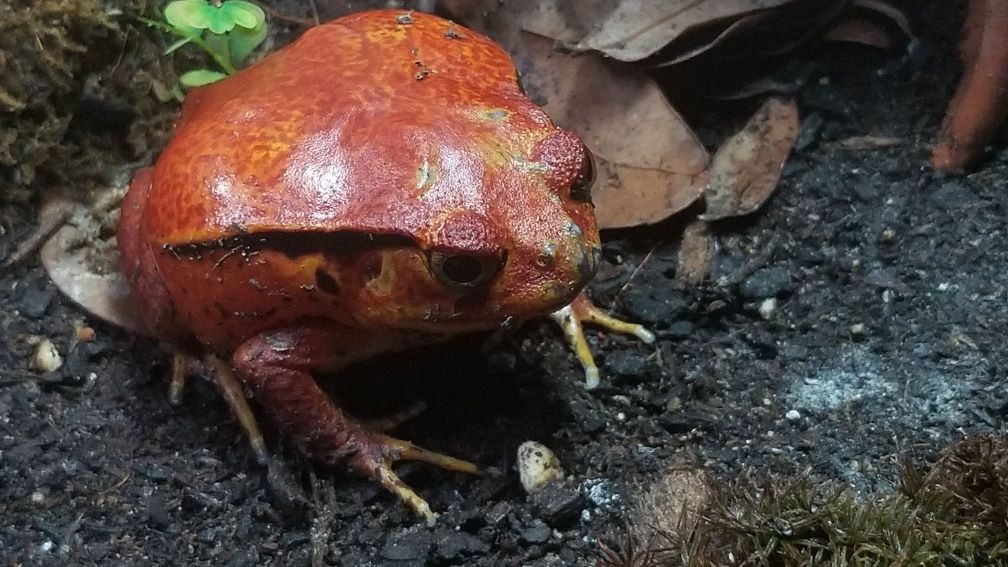
Sambava / False Tomato Frog (Dyscophus guineti)

Care level: Beginner-Intermediate

Temperament: Great feeding response but might be a bit shy when younger; not recommended for handling

Minimum enclosure size: 40B (36×18×18” (90×45×45cm)) 

Enclosure temp: 68-80°F (20-27°C); substrate should be at least 4-5” (10-13cm) high to allow for burrowing and a temperature gradient

Nighttime/minimum temp: 65°F (18°C)

UVB: UVI zone 0.5-1/Ferguson zone 1 (e.g. Arcadia Shadedweller 7% at 18+” (45+cm) with no mesh or at 12+” (30+cm) over typical mesh)

Humidity: 60-80%

Diet: Insects and other small invertebrates such as nightcrawlers (pinkies are ok as an occasional treat, but never more than once a month)

Adult size: Females – 3.5-4” (9-10cm); males 2.5-3” (6-8cm)

(guide written with contributions by TuRbLe#2023)


Other Resources:

Dubia.com Guide – Tomato Frog

AmphibiaWeb – Dyscophus guineti

Categories
Amphibian Basic Care Guides

Green Tree Frog (Dryophytes cinereus)

Care level: Beginner

Temperament: Timid and jumpy

Minimum enclosure size: 12×12×18” for 1-2 frogs

Basking spot temp (surface): 80-84°F (27-29°C)

Cold side temp: 72-75°F (22-24°C)

Nighttime/minimum temp: 65°F (18°C)

UVB: UVI zone 0.5-1/Ferguson zone 1 (e.g. Arcadia Shadedweller Arboreal 2.5% at 2-4″ (5-10cm) with no mesh or Arcadia Shadedweller 7% at 12+” (30+cm) with typical mesh)

Humidity: Day – 50-60%; night – 80-100%

Diet: Insectivore

Adult size: Up to 2.5” (6cm)

(care guide written with contributions by mandi#6740)


Other Resources:

Dubia.com Guide – Green Tree Frog

ADW – Dryophytes cinerea (formerly Hyla cinerea)

AmphibiaWeb – Dryophytes cinerea (formerly Hyla cinerea)

Categories
Amphibian Basic Care Guides

African Clawed Frog (Xenopus laevis)

Care level: Beginner

Temperament: Docile and personable, but not for handling

Behavior: active at various times throughout the day/night, aquatic, solitary (non-aggressive to others)

Minimum enclosure size: 20 gallons (90L)

Water temp: 65-75°F (18-24°C)

Lighting: LED or normal aquarium lights can be used

Diet: Soft-bodied invertebrates like nightcrawlers and waxworms as well as commercial foods, fish, and brine shrimp

Adult size: 4-5” (10-13cm)

Wild Distribution: stagnant grassland pools/ponds and streams in southern Africa; introduced populations in California, Chile, Great Britain, and other regions

(care guide written with contributions by mandi#6740)


Other Resources:

Dubia.com Guide – African Clawed Frog

ADW – Xenopus laevis

AmphibiaWeb – Xenopus laevis

Categories
Amphibian Basic Care Guides

Pacman / Horned Frog (Ceratophrys spp.)

Common Species: Ceratophrys cranwelli (Cranwell’s horned/pacman frog), Ceratophrys aurita (Brazilian horned/pacman frog), Ceratophrys cornuta (Surinam horned/pacman frog), Ceratophrys ornata (ornate pacman frog or Argentine horned/pacman frog), and Ceratophrys cranwelli x C. cornuta hybrids (fantasy pacman frog)

Care level: Beginner-intermediate

Temperament: Very eager feeding response; not for handling

Behavior: crepuscular/nocturnal, terrestrial/fossorial, solitary

Minimum enclosure size: 40B (36×18×18”(90×45×45cm)) 

Warm side temp: most species 80-85°F (27-30°C); C. ornata and C. aurita 75-80°F (25-27°C)

Cold side temp: 70-75°F (21-24°C)

Nighttime/minimum temp: 60°F (16°C)

UVB: UVI zone 0.5-1/Ferguson zone 1 (e.g. Arcadia Shadedweller 7% at 18+” (45+cm) with no mesh or at 12+” (30+cm) over typical mesh)

Humidity: varies by species; C. cranwelli 50-75%, C. ornata 70-80%, C. cornuta and C. aurita 75-85% (higher in the wet season)

Diet: Insects (occasionally rodents, fish and frogs/lizards) 

Adult size: Up to 6” (15cm)

(care guide written with contributions by mandi#6740)


Species specific notes:

Ceratophrys cranwelli –

  • native to the Gran Chaco region of Argentina, Bolivia, Paraguay and Brazil
  • mainly dry, thorny forests as well as savannas, hardwood forests and inland wetlands
  • Soil in the area is sandy and clay based
  • Temperatures range from 60-85°F and humidity 50-75%

Ceratophrys ornata –

  • Native to the Pampas region of Argentina
  • Mainly subtropical grasslands and seasonal wetlands; frogs are found mainly around seasonal bodies of water
  • The area is grassy and shrubs with a few trees
  • Soil in the area ranges from fertile and moist to sandy and loamy with some clay
  • Temperatures range 55-75°F (average 65°F) and humidity 70-80%

Ceratophrys cornuta –

  • Native to the Amazon rainforest and Amazon basin
  • Forests are terra firma (firm, dry soil) or dense forest
  • Frogs are found burrowed under leaf litter next to roots or logs; more active when there is rainfall
  • Soil in the area is mainly loam with silt and/or clay
  • Temperatures range 70-90°F (average 77°F); humidity 77% in the dry season and 88% in the wet season

Ceratophrys aurita –

  • Native to the Atlantic forests of Argentina, Brazil, Paraguay and Uruguay
  • Forests are dense with rich diversity of plants
  • Frogs are found near seasonal (sometimes permanent) ponds in the forest and at the edge of the forest, under leaf litter
  • Soil in the area is sandy with clay
  • Temperatures range 65-86°F (average 71-75°F); humidity 63-96%

Other Resources:

Dubia.com Guide – Pacman Frog

How Can We Do Better By Pacman Frogs? (information on species care differences and advanced husbandry)

Ornate Pacman Frog Guide by bufomancer

ADW – Ceratophrys cornuta

AmphibiaWeb – Ceratophrys cornuta

AmphibiaWeb – Ceratophrys cranwelli

AmphibiaWeb – Ceratophrys ornata
Categories
Reptile Basic Care Guides

Axolotl (Ambystoma mexicanum)

Care level: Intermediate

Temperament: Can be very personable, but not handleable

Behavior: active throughout night/day, aquatic, solitary

Minimum enclosure size: 40 gallons (180L)

Water temp: 60-68°F (16-20°C); over 68°F (20°C) can become dangerous

Lighting: No lighting needed, although plant lighting can be used for 6 hours or less per day

Diet: Soft-bodied invertebrates like nightcrawlers as well as occasional soft sinking salmon pellets

Adult size: about 12” (30cm)

Wild Distribution: lakes and wetlands throughout the Mexican Central Valley; very rarely found in the wild now

(care guide written with contributions by mandi#6740)


Other Resources:

Axolotl Central Care Guide

Dubia.com Guide – Axolotl

ADW – Ambystoma mexicanum

Categories
Reptile Basic Care Guides

White’s Tree Frog (Ranoidea caerulea)

Care level: Beginner

Temperament: Docile

Behavior: primarily crepuscular/nocturnal, arboreal/semi-arboreal, semi-social (can live alone or with others)

Minimum enclosure size: 18×18×24” (45×45×60cm) for 1-2 frogs

Basking spot temp (surface): 80-85°F (27-30°C)

Cold side temp: 70-75°F (21-24°C)

Nighttime/minimum temp: 65°F (18°C)

UVB: UVI zone 0.5-1/Ferguson zone 1 (e.g. Arcadia Shadedweller Arboreal 2.5% at 2-4″ (5-10cm) with no mesh or Arcadia Shadedweller 7% at 12+” (30+cm) with typical mesh)

Humidity: Babies and juveniles – 60-75%; adults – 45-60%

Diet: Insectivorous

Adult size: Up to 5″ (13cm)

Wild Distribution: many different environments including moist forests and suburban areas (often seasonally dry areas) in Australia and New South Guinea

(care guide written with contributions by mandi#6740)


Other Resources:

Dubia.com Guide – White’s Tree Frog

The BioDude Guide – White’s Tree Frog (includes info on bioactive)

ADW – Ranoidea caerulea (formerly Litoria caerulea)

Categories
Reptile Basic Care Guides

Children’s Python (Antaresia childreni)

Care level: Beginner

Temperament: Generally docile, but can be bitey and defensive when young

Behavior: crepuscular, terrestrial/semi-arboreal, solitary

Minimum enclosure size: 40B (36×18×18”(90×45×45cm))

Basking spot temp (surface): 90-100°F (32-38°C)

Cold side temp: 78-80°F (25-27°C)

Nighttime/minimum temp: 60°F (16°C)

UVB: UVI 1-3/Ferguson zone 2 (e.g. Arcadia Shadedweller 7% at 12-15” (30-40cm) away with no mesh or Arcadia T5HO 6% at 11-21”(28-54cm) away with typical mesh) 

Humidity: Around 50%

Diet: Carnivorous; mainly small mammals with occasional reptiles and avians 

Adult size: 2-4’ (60-120cm)

Wild Distribution: various habitats such as forests, savannas, grasslands, wetlands, and shrublands in northern Australia

(guide written with contributions by mandi#6740)


Other Resources:

Dubia.com Guide – Children’s Python

IUCN – Antaresia childreni

Categories
Reptile Basic Care Guides

Green Anole and Brown Anole (Anolis carolinensis and A. sagrei)

Care level: Intermediate

Temperament: Active and jumpy; may be able to get used to handling but often not handleable

Behavior: diurnal, arboreal, solitary (semi-social in the wild when breeding)

Minimum enclosure size: 24×24×24” (60×60×60cm)

Basking spot temp (surface): 90°F (32°C)

Cold side temp: 75-80°F (24-27°C)

Nighttime/minimum temp: 65-75°F (18-24°C)

UVB: UVI 2-4/ Ferguson zone 2-3 (e.g. Arcadia T5HO 6% at 11-16” (28-41cm) away with no mesh or 7-11” (18-28cm) over typical mesh)

Humidity: 60-70%

Diet: Insectivorous

Adult size: Up to 8.5″ (21cm)

Wild Distribution: many habitats including urban/suburban areas throughout southeastern United States (Anolis carolinensis) and Central America/Caribbean (Anolis sagrei)

(care guide written with contributions by mandi#6740)


Other Resources:

ReptiFiles Guide – Green Anole

Dubia.com Guide – Brown/Green Anole

ADW – Anolis sagrei (formerly Norops sagrei)

ADW – Anolis carolinensis

Categories
Reptile Basic Care Guides

Tokay Gecko (Gekko gecko)

Care level: Intermediate

Temperament: Defensive; very willing to bite, not usually very handleable at all although captive-bred individuals can be better

Behavior: crepuscular, arboreal, solitary (semi-social in the wild when breeding)

Minimum enclosure size: 24×24×36” (60×60×90cm) 

Basking spot temp (surface): 95-105°F (35-40.5°C)

Cold side temp: 70-75°F (21-24°C)

Nighttime/minimum temp: 65-70°F (18-21°C)

UVB: UVI zone 0.5-1/Ferguson zone 1 (e.g. Arcadia Shadedweller Arboreal 2.5% at 2-4″ (5-10cm) with no mesh or Arcadia Shadedweller 7% at 12+” (30+cm) with typical mesh)

Humidity: 60-80%

Diet: Insectivore; assortment of insect and invertebrate feeders with small vertebrate feeders infrequently

Adult size: Males – 13-16” (35-40cm); females – 8-12” (20-30cm)

Wild Distribution: tropical rainforests and urban areas throughout southeast Asia; invasive in Florida and Hawaii

(care guide written with contributions by mandi#6740)


Other Resources:

ReptiFiles Guide – Tokay Gecko

Dubia.com Guide – Tokay Gecko

ADW – Gekko gecko